Signs You Grind Your Teeth at Night — and Who Notices
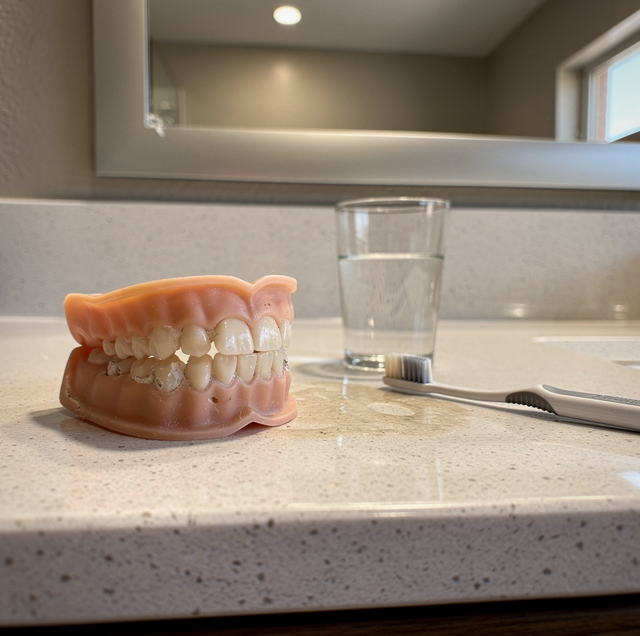
A canine tip that used to come to a point goes flat and glassy, and a molar cusp beside it rounds down into a shallow dip. These are the marks nighttime grinding leaves behind, and they usually turn up long before the person carrying them has any memory of grinding anything.
Quick Answer: Nighttime grinding is noticed indirectly: soreness in the jaw on waking, a dull morning headache, teeth that look shorter or chip at the edges, and sometimes a sound a bed partner hears. A dentist evaluates the pattern.
Sleep bruxism is the clinical term for clenching and grinding that happens during sleep. It is muscle activity rather than a habit anyone can decide to stop mid-sleep, and it goes unfelt by most of the people doing it. The jaw muscles can produce far more force than ordinary chewing calls for, and the reflex that normally tells you to ease off a hard bite is dulled while you sleep. That is why the evidence collects on the teeth and in the muscles instead of in your recollection of the night, and why the clues sort themselves by who is in a position to see them.
What You Notice First Thing in the Morning
The earliest sign often has nothing to do with teeth. It is the jaw itself, sore or stiff in the first hour after waking, carrying the dull ache of a muscle that has been working all night. The soreness sits along the sides of the face, below and in front of the ears, and it tends to ease as the morning goes on rather than build through the day. That direction is the informative part: discomfort loudest at six in the morning and gone by lunch points somewhere different than discomfort that grows while you work.
A dull headache in the temples on waking follows the same arc. The temporalis muscle fans across the side of the skull above the ear and helps close the jaw, so a night of sustained closing can leave it tender in a band many people read as an ordinary tension headache.
Teeth can feel bruised rather than sharp. Each tooth hangs in its socket on a ligament, and hours of sustained pressure load that ligament. The result is a vague tenderness when biting that fades throughout the morning, usually affecting several teeth at once rather than a single spot.
Sleep quality belongs here too. Grinding comes in bursts that can fragment sleep without waking you fully, so some people wake unrefreshed or fade in the afternoon without connecting it to their jaw. On its own, that means little. Alongside the soreness, it is one more piece.
Sensitivity sometimes joins in. A single tooth that reacts sharply to cold has several possible causes, and sorting out which one applies is an exam question rather than something to settle at the bathroom sink. What belongs to this pattern is the timing and the spread: mild sensitivity that is worst right after waking, quieter by afternoon, and present in more than one tooth without any new cavity or new filling to explain it.
One rough morning carries almost no information by itself: Everyone wakes up stiff occasionally. What a dentist listens for is repetition over weeks and the way several of these signs travel together.
What a Bed Partner or Family Member Notices
Grinding has a sound, and the person making it almost never hears it. Partners describe a grating or creaking noise, short bursts lasting seconds rather than a continuous drone, repeating through the night and often clustered in the lighter stretches of sleep. Some people hear it through a wall.
Silence proves nothing, though. Clenching is static: the teeth are pressed together and held without sliding, so it makes no sound. Someone can clench hard for hours beside a person who has never heard a thing. A partner who reports nothing has ruled out one clue, not the activity.
A partner may also notice things that belong to a different category. Loud snoring, gasping, or breathing that seems to pause and restart is not grinding, though the two can sometimes occur in the same person. Interpreting that is not a job for either of you. A dentist asks about sleep and breathing as part of the health history, looks for signs of it in the mouth and throat, and refers to a physician or sleep specialist when the picture calls for it.
Tell your dentist and your physician if anyone has observed loud snoring, choking sounds, or pauses in your breathing during sleep. Those observations belong in your medical history and are evaluated by a professional, never self-assessed at home.
What the Teeth Themselves Show
Wear from grinding has a look that differs from ordinary aging. The biting edges of the lower front teeth flatten into a level line, and the upper front teeth lose the gentle scallop they had when they came in. Canine tips lose their point and take on a small polished facet, flat and slightly reflective, because enamel sliding against enamel burnishes as it wears.
Chips and thin vertical craze lines can appear along the edges of front teeth, often several at once with no single event to blame. Some people notice the edges feel rougher to the tongue before they look different in the mirror.
Wedge-shaped notches near the gumline sometimes appear as well. Their relationship to grinding is debated rather than settled, since brushing force and acid exposure are part of that discussion too, so a notch is one observation among several rather than proof of anything.
A wear pattern tells a dentist how a tooth has been loaded; it does not indicate how much sound structure remains underneath, and that is what determines how a cracked tooth is rebuilt.
Some people also describe a tooth that feels faintly loose. Pressure held for hours can do that, but mobility has other causes worth ruling out, so it is a finding to report rather than to test at home.
None of this supports grading your own enamel. Grinding wear, acid wear, and the slow thinning of decades can look alike in a mirror, and they are told apart against your own records.
What Shows Up in the Jaw, Head, and Ears
The muscles that do the work tend to complain in ways that are easy to attribute elsewhere. Jaw fatigue partway through a meal, particularly with chewy food, is common. So is a jaw that feels tight when you first open wide in the morning.
The temporomandibular joint sits directly in front of the ear canal, which is why joint irritation is so often described as an earache. People book with a physician expecting an ear infection and find the ear is clear. Clicking or popping when opening, a catch on one side, or a sense that the opening is smaller than it used to be belong to the joint rather than the ear, and all are things a dentist assesses rather than conclusions to reach alone.
Over longer stretches, the masseter muscle at the angle of the jaw can thicken with sustained use, giving the lower face a squarer outline. The change is gradual enough that old photographs often reveal it before a daily mirror does.
What a Night Guard Does with the Force
The force does not disappear when a guard goes in. It gets redirected, and knowing where it goes is the point.
A custom night guard places a rigid layer between the upper and lower teeth, so that sliding, pressing contact occurs between a tooth and the appliance rather than between enamel and enamel. Enamel does not grow back once it is worn away, and the appliance is meant to take the scratching and scuffing that would otherwise land on biting surfaces. The guard also spreads the load across many teeth instead of letting it land on whichever few teeth happen to meet first.
A guard changes what the force lands on while the muscle activity continues unchanged. It is commonly used to protect tooth structure and reduce strain on the chewing muscles, and it is intended as a barrier, not a cure for grinding itself. Anyone promising that an appliance will end the behavior is overstating what a piece of plastic can do.
Fit is what separates a guard that helps from one that sits in a drawer. A dentist adjusts the biting surface so contact is even, checks how the appliance sits when the jaw slides side to side, and rechecks it over time as it wears. Whether a guard suits a given person and which design fits their bite are decisions made after an exam.
Bring the guard to every checkup. Thinning, a perforation, or a dull polished patch concentrated in one area tells the dentist where the force is landing, which is information no mirror check at home can give.
What a Dentist Confirms at the Visit
The visit starts with questions, because the pattern matters more than any single finding: when the soreness is worst, what a partner has reported, how headaches behave, what your sleep has been like.
Then the exam looks for things that are hard to see from your side of the mirror. A dentist guides the jaw into a side-to-side slide to see whether worn spots on the upper and lower teeth line up, which tells a different story than wear scattered without a matching partner. The chewing muscles are pressed to check for tenderness; the joint is listened to and felt during opening; and the extent of jaw opening is measured rather than estimated.
Soft tissue gets a look too. A pale horizontal ridge along the inside of the cheek at the level where the teeth meet, called the linea alba, and scalloped indentations along the borders of the tongue can both reflect pressure held over long periods.
The most useful thing in the room is usually the file. Photographs, models, and X-rays from earlier visits give a baseline no amount of squinting in a mirror can reconstruct, and comparing today's edges against that record is how a dentist separates real change from a mouth that has always looked that way. That comparison, with your history and the muscle and joint findings, is what turns loose clues into something a professional can act on.
Frequently Asked Questions
Grinding is common in children and often lessens on its own as the baby teeth are shed and the permanent teeth arrive. Appliances are handled differently in a growing mouth, since anything covering the teeth can affect eruption and jaw development, so a dentist usually monitors the wear and the child's comfort across visits rather than fitting an adult-style guard.
Either arch can work, and the choice is clinical. An upper guard is the more common default. A lower guard is often preferred for a strong gag reflex, for mouth breathing at night, or when an upper appliance would interfere with an existing partial denture or bridge. The dentist decides based on how your bite comes together.
It depends heavily on material and on how hard you grind. Soft thermoplastic guards wear through fastest, dual-laminate guards sit in the middle, and hard acrylic lasts longest but takes the most adjustment to fit comfortably. How fast a guard wears through is itself useful information, and a guard that thins quickly usually means the next one is made in a harder material rather than the same one again.
No. Boil-and-bite trays are softened in hot water and shaped by biting, which results in a bulky fit and uneven thickness. Some people find the softer material invites chewing rather than discouraging it. A custom guard is made from an impression or a digital scan of your arches.
They are treated as separate behaviors. Awake bruxism is usually caught by the person doing it, during concentration, driving, or lifting, rather than reported by someone else. An appliance worn only during sleep does nothing during the daytime, which is why a dentist asks about jaw posture throughout the day as a separate question.
Fit is checked over time for exactly this reason. An appliance that covers only a few front teeth leaves the back teeth free of contact, and teeth without an opposing partner can drift or over-erupt, which shifts the bite. Full-arch coverage keeps every tooth in contact with the appliance, and periodic rechecks confirm the bite has not moved.
Bring the pattern to your next exam — morning soreness, worn edges, or a partner who hears grinding are all worth mentioning so a dentist can evaluate what is happening and discuss whether a night guard fits. Jennifer Fineberg DDS welcomes patients in Glendale, Peoria, and the West Valley. Call (623) 362-2550.
