Glendale Dentist Explains Early Signs of Gum Disease
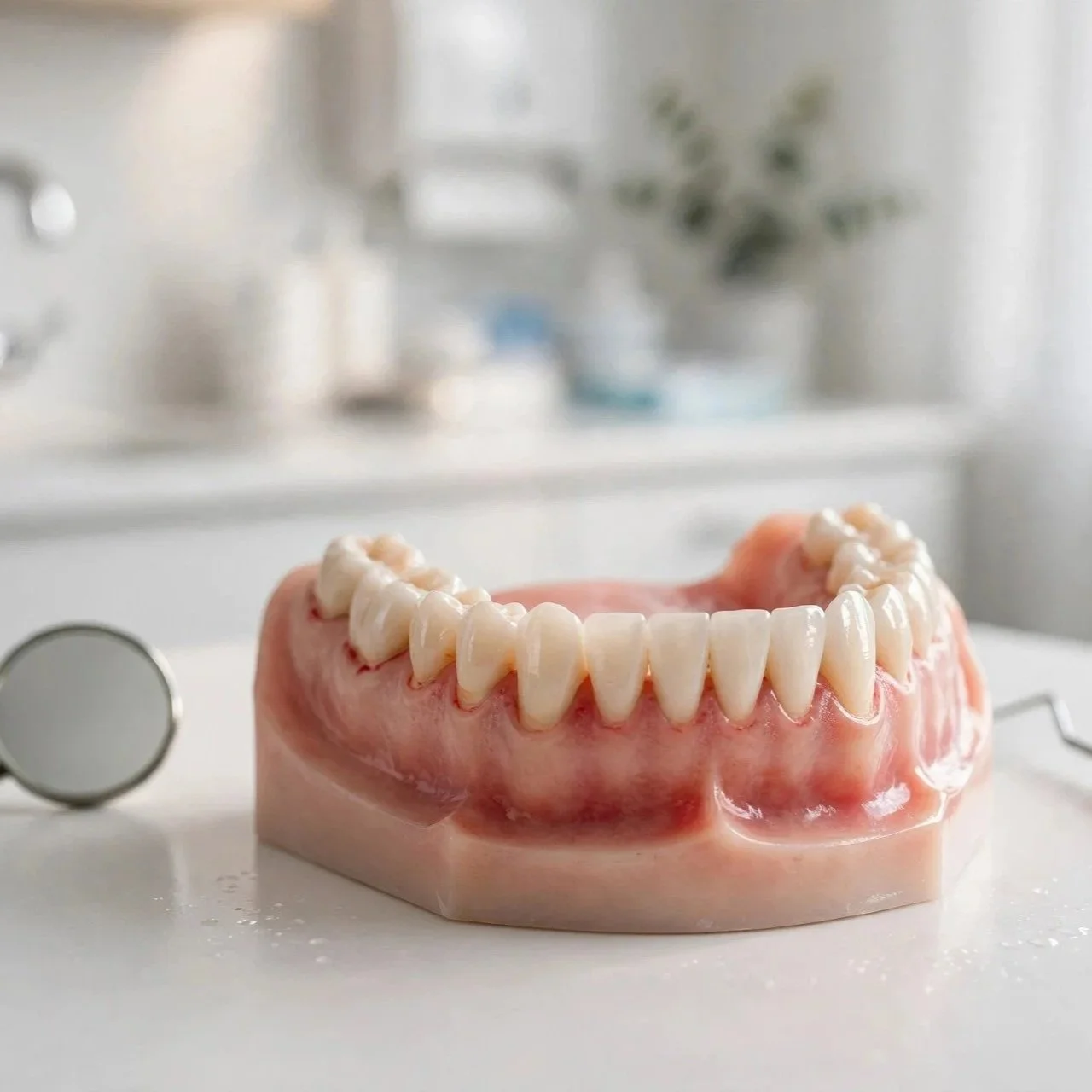
Gum disease is one of the most common conditions a dentist treats, and also one of the quietest. In its early stage, it rarely hurts. There is no throbbing tooth to send you looking for help, just small shifts at the gumline that are easy to wave off as nothing. That is exactly what makes the early signs worth knowing. The stage where gum disease is simplest to turn around is also the stage where it asks the least of your attention. By the time it does start to hurt, the process is usually further along and harder to reverse.
The goal here is not to alarm you, but to help you read the quiet signals early and know when those changes are worth a professional look.
Why the Early Stage Slips By
Gum disease starts with plaque, the soft, sticky film of bacteria that forms on teeth every day. Where plaque sits undisturbed, especially right along the gumline and between teeth, the bacteria irritate the gum tissue, and the body responds with inflammation. Left in place, plaque hardens into tartar, also called calculus, as minerals in your saliva bind to it. Tartar is rough, porous, and firmly stuck, and a toothbrush cannot remove it once it has set. It holds more bacteria against the gum and keeps the irritation going.
The reason this early phase is so easy to miss is that gum inflammation is usually painless. There are a few pain nerves in the gum tissue reacting to this kind of low-grade irritation, so your body does not sound an alarm the way it does with a cavity that reaches a nerve. The signs are visual and subtle instead: a little color change, a little puffiness, a spot of blood in the sink. None of them demands attention, which is precisely why they get ignored.
The Warning Signs Worth Knowing
No single sign confirms gum disease on its own, and only a dentist can evaluate what is actually going on. But these are the changes that most often show up first, and knowing the mechanism behind each one makes them easier to take seriously.
Gums that bleed easily: Healthy gums generally do not bleed when you brush or floss with a normal touch. When the gums are inflamed, the tiny blood vessels near the surface become swollen and fragile, so gentle pressure can make them bleed. Occasional bleeding after a rough flossing session is one thing, but gums that bleed routinely are worth noting rather than treating as normal. It is one of the earliest and most reliable clues, though only one of several signs.
Redness, puffiness, or tenderness: Firm, pale pink gums that hug each tooth are the healthy baseline. Inflamed gums tend to look darker or redder, feel slightly swollen or spongy, and may be tender when touched. The gum line can start to look rounded or bloated instead of scalloped and snug. These changes reflect the same underlying inflammation as bleeding and show up on the surface as changes in color and texture.
Persistent bad breath or a lingering bad taste: The bacteria involved in gum disease release volatile sulfur compounds as they break down debris below the gumline, and those compounds carry a distinct odor. Breath that stays bad after brushing, flossing, and cleaning your tongue, or an odd taste that keeps returning, can point to bacteria collecting where a brush does not reach. Ordinary morning breath clears up quickly; the kind tied to gum inflammation tends to keep coming back.
Gums that look like they are pulling back: When inflammation lingers, gum tissue can begin to recede, sitting lower on the teeth than before. The common way people notice this is that their teeth look longer, or a tooth suddenly seems to have more length near the gum. Recession can expose the root surface, which is softer than enamel and more vulnerable. Once gum tissue has receded, it does not grow back on its own, which is another reason catching the earlier signs matters.
New sensitivity along the gumline: As gums recede or pull slightly away from the tooth, they can expose the root and the sensitive area near the neck of the tooth. That often shows up as a twinge with cold, heat, or sweet foods, felt low on the tooth rather than at the biting surface. Sensitivity has several possible causes, so it is not proof of gum disease by itself, but sensitivity that tracks with other gum changes is worth mentioning at your next visit.
Small changes right at the gumline: Sometimes the earliest hint is nothing dramatic: a slight shift in the color or contour of the gum around one or two teeth, or a small gap opening where the gum used to sit tight. These localized changes are easy to overlook because they do not hurt and do not spread all at once, but they are still worth pointing out during a checkup.
From Gingivitis to Periodontitis: Why Early Action Matters
The single most useful thing to understand about gum disease is that it moves through stages, and the stages are not equally reversible.
The early, inflammation-only stage is called gingivitis. At this point, the irritation is limited to the gum tissue itself. The fibers and bone that anchor the tooth have not been damaged. Gingivitis is generally reversible: with thorough professional cleaning to remove tartar and consistent brushing and flossing at home, inflamed gums can settle back down and return to health. This is the window where the least effort accomplishes the most.
If plaque and tartar keep sitting below the gumline, gingivitis can progress to periodontitis. Here, the process reaches deeper. Between a healthy tooth and gum, there is a shallow groove, called the sulcus, usually about one to three millimeters deep, that a dentist measures gently with a small probe. As periodontitis develops, the gum detaches from the tooth, and that groove deepens into a pocket. Pockets of four millimeters or more are harder to keep clean and trap even more bacteria. Over time, the disease can break down the fibers and the underlying jawbone, the alveolar bone, that hold teeth in place. That is why advanced gum disease can eventually loosen or shift teeth.
The important distinction is this: the bone and attachment lost to periodontitis do not simply grow back. Periodontitis is managed rather than reversed. With professional care, including cleaning below the gumline, the disease can often be brought under control, and further loss slowed or stopped, but the goal shifts from cure to control. That shift, from a stage you can reverse to one you can only manage, is the reason the early signs deserve attention instead of waiting and seeing.
When to Have Your Gums Looked At
You do not need to diagnose yourself, and you should not try to. What the signs above give you is a reason to have a dentist take a proper look. A dental exam checks the things you cannot assess in a mirror: along with looking at the color and texture of your gums, a dentist or hygienist uses that small probe to measure the depth of the space between gum and tooth at several points around each tooth, and may take X-rays to check the bone level. Those measurements are how gingivitis is told apart from periodontitis, and how any change is tracked over time.
Bleeding that keeps happening, gums that look red or puffy, breath or a taste that will not clear, receding gums, or new sensitivity at the gumline are all good reasons to book an evaluation rather than watch and hope. Routine checkups help for the same reason: a dentist can often spot the earliest gum changes before you would, at the stage when they are easiest to resolve.
What the Early Signs Add Up To
Taken one at a time, none of these signals looks urgent, and that is the whole problem. A little blood, a little puffiness, breath that will not quite clear, a tooth that looks slightly longer than it did: each is minor and painless on its own, so each is easy to postpone. Read together, they describe a process that is far simpler to handle early than late. Treating those quiet clues as information rather than as nothing is what keeps a reversible problem from becoming one you can only manage. If any of them sound familiar, a professional evaluation is the sensible next move.
Frequently Asked Questions
Yes. Bleeding is a common early sign, but its absence does not clear you. People who smoke or use tobacco often bleed less because nicotine narrows the small blood vessels in the gums, which can mask inflammation and make gum disease look milder than it is. Certain medications and individual differences can also reduce visible bleeding. That is one reason a professional exam, which measures pocket depth directly, catches problems that a mirror check can miss.
Ordinary bad breath usually comes from food, a dry mouth, or bacteria on the tongue, and it clears with brushing, tongue cleaning, and water. The odor linked to gum disease comes from bacteria in the pockets below the gumline that a brush cannot reach, so it tends to return no matter how carefully you clean the surfaces you can get to. A telling detail is that cleaning the tongue, which shifts a lot of everyday breath odor, does little for this kind, because the source sits under the gum rather than on top of it. Some people also notice a lingering metallic or foul taste along with the smell. Breath that stays stubborn despite good hygiene, especially paired with that sort of taste, points more toward something happening below the gumline.
No. Gum tissue that has receded does not regenerate on its own, and better brushing will not regrow it. What good care does is stop or slow further recession by removing the irritation driving it. In some cases, a dentist may discuss grafting options to cover exposed roots, but the realistic aim once recession has happened is to protect what remains, which is why acting before it sets in is worth it.
Yes, though it usually takes the reversible, gingivitis form. Inflamed, bleeding gums are fairly common in adolescence, partly because hormonal changes can make gum tissue respond more strongly to plaque, and partly because home care is often inconsistent at that age. Braces also create more spots for plaque to hide. The good news is that at this stage, it responds well to thorough cleaning and better daily habits, which is worth reinforcing early.
It can. Saliva is the mouth's natural rinse, buffering acids and helping wash bacteria and debris away, so when saliva runs low, there is less of that protection, and irritation can take hold more easily. Dry mouth is a common side effect of many medications and tends to be more noticeable in a dry climate, where heat in the warm months and indoor heating in the cooler months can both leave the mouth drier. Staying well hydrated and mentioning a persistently dry mouth to your dentist both help.
For most people, the gum evaluation happens as part of a routine dental checkup and cleaning, and many patients are seen about twice a year. People with a history of gum disease, or with risk factors such as tobacco use or diabetes, are sometimes advised to come in more often so any change can be caught early. Your dentist sets the interval based on your own gum measurements and history rather than a single rule that fits everyone.
Notice any of these early signs? Have your gums evaluated before a reversible problem becomes one that must be managed. Jennifer Fineberg DDS welcomes patients in Glendale, Peoria, and the West Valley. Call (623) 362-2550.
