Missing One Tooth? Dental Bridge vs. Implant Options in Glendale, Arizona
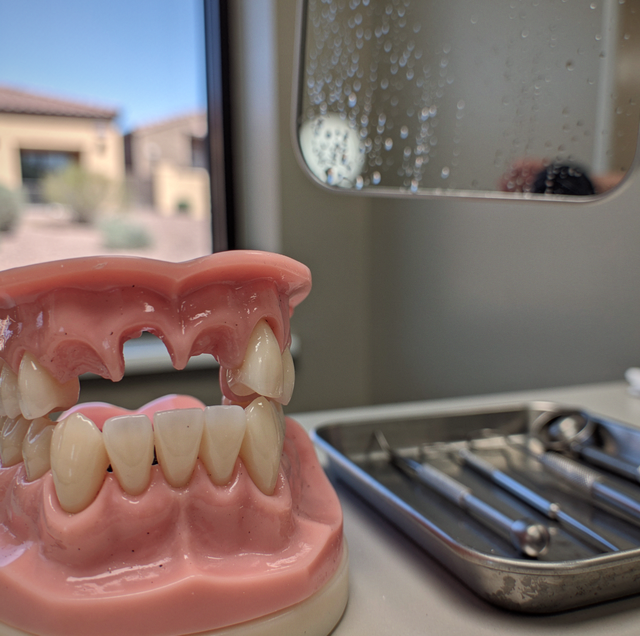
Quick Answer: A bridge closes a gap by crowning the teeth on either side and suspending a replacement tooth between them, with no surgery and a timeline measured in weeks. An implant sets a post into the jawbone beneath the gap, leaves the neighboring teeth untouched, and keeps that stretch of bone under load. The condition of those neighboring teeth and the amount of healthy bone under the space are usually what point a dentist toward one or the other.
The socket healed weeks ago and the soreness is long gone. What remains is a space your tongue finds every time your mind wanders, and a question that came up at your last visit in a single breath: bridge or implant. Both close the gap and give you something to chew with on that side again. They arrive there in nearly opposite ways, though, and the choice turns on things you cannot see in a mirror, starting with the two teeth flanking the space and the bone beneath it.
One Gap, Two Different Kinds of Repair
The difference is easiest to hold onto as a question of where support comes from. A bridge borrows it: the teeth flanking the gap become anchors, and the replacement tooth hangs between them, carried by their roots. An implant builds its own. A post goes into the jawbone where the missing root used to sit, and the replacement tooth stands on it without asking anything of the neighbors.
Neither is the automatic winner. A bridge can be the sounder plan for one patient and a poor use of two healthy teeth for the next. What follows is general education about how each works and what dentists weigh, not a verdict on your gap.
How a Bridge Replaces a Tooth
A traditional fixed bridge is a single solid structure with three parts: a crown on each side and a false tooth, called a pontic, joining them. The crowned teeth are known as abutments, and they take on the chewing work of the missing tooth along with their own.
Making it starts with reducing those two abutment teeth. Enamel is trimmed from all sides so a crown fits over each one without adding bulk against the cheek. That reduction is permanent, the single biggest trade in the plan, because enamel does not grow back and a prepared tooth will need a crown from then on. A scan or impression captures the shape, a temporary bridge protects the teeth, and a dental laboratory builds the finished piece in porcelain fused to metal, zirconia, or an all-ceramic material. At a second visit, it is fitted, checked against your bite, and cemented.
Once cemented, it stays. You do not take a fixed bridge out the way you would a removable partial denture. All three units are locked together, so floss cannot pass between them as it does between natural teeth, and cleaning under the pontic takes a different tool.
How an Implant Replaces a Tooth
An implant rebuilds the tooth from the root up. A small titanium post is placed into the jawbone at the site of the missing tooth. Over a healing period, living bone grows tight against its surface and locks it in, a bonding process called osseointegration. A connector called an abutment is then attached, and a crown is made to fit on top. The result is a single freestanding tooth with nothing joining it to the adjacent teeth.
That independence is the main appeal. The neighbors keep their enamel, you floss around the implant much as you would a natural tooth, and because the post is loaded every time you chew, the bone at that spot keeps getting the signal it needs to hold its shape.
The trade is that placing the post is a minor surgical procedure followed by months of healing before the crown goes on. Some sites need groundwork first, such as a bone graft to rebuild volume, or a sinus lift in the upper back jaw where the sinus sits close above the roots. Where a case calls for surgical work beyond what a general practice handles in-house, that portion is planned with a specialist while your general dentist manages the restorative side.
Bridge vs. Implant, Side by Side
No single row settles it. A dentist reads them together, and one strong factor can outweigh several smaller ones.
| Fixed bridge | Single implant | |
|---|---|---|
| Procedure invasiveness | No surgery; enamel permanently reduced on both neighboring teeth | Minor oral surgery for the post; neighboring teeth untouched |
| Typical timeline | About two visits over a few weeks | Commonly several months, longer if grafting comes first |
| Effect on the jawbone | Pontic rests on the gum, so the ridge underneath keeps shrinking | Post loads the bone, helping the site hold its shape |
| Longevity and durability | Often serves a decade or more; risk sits at the crown margins | Post survival commonly reported as high at ten years; the crown may need attention sooner |
| Care and maintenance | Floss threader, bridge floss, interdental brush, or water flosser under the pontic | Brushing and flossing much like a natural tooth, plus gum checks |
| Main candidacy factors | Sound teeth with good gum support on both sides of the gap | Enough bone height and width, healthy gums, a jaw finished growing |
| If something goes wrong | The unit usually comes off together, involving both abutment teeth | The crown or abutment can often be addressed alone |
What the Neighboring Teeth Are Telling the Dentist
The two teeth beside the gap often cast the deciding vote, and their condition matters more than their number.
If both are untouched, with no fillings and no history of trouble, grinding them down to hold a bridge sacrifices healthy structure. A prepared tooth also carries a small ongoing risk of the nerve becoming irritated later and needing root canal treatment, which carries more weight for a tooth that was fine to begin with.
If one or both already carry large fillings, cracks, worn cusps, or existing crowns, the calculation shifts. Those teeth may be heading toward crowns anyway, so a bridge handles two problems in one restoration.
A dentist also checks how firmly each abutment sits in bone, since a bridge asks two roots to carry three teeth. Deep periodontal pockets, looseness, short or thin roots, or a tooth tipped at an angle all work against that. Heavy clenching adds force to either option and often brings a night guard into the plan.
What the Bone Under the Gap Is Doing
Jawbone responds to use. Bone surrounds a tooth root partly because that root transmits chewing force into it, and once the root is gone, the body reclaims material it no longer needs. This shrinking, called resorption, tends to be quickest in the first several months after a tooth is lost, and the ridge loses width as well as height.
That single fact pulls in both directions. An implant keeps loading the bone and helps the ridge hold its shape, the strongest argument in its favor for a younger patient facing decades with the same gap. A bridge does nothing to slow the process, because the pontic floats above the gum rather than passing force downward. Years later, a small hollow can open under a bridge as the ridge recedes, trapping food and, on a front tooth, sometimes showing as a dark shadow at the gumline.
The same bone determines whether an implant is possible at all. Enough height and width have to be there to hold a post safely away from the sinus above or the nerve canal in the lower jaw. Where the ridge has already thinned, grafting can often rebuild it, though that adds a healing stage first. Imaging turns guesswork into measurement, and a long-empty site is the kind that needs measuring rather than assuming.
Time, Surgery, and Healing
Speed is where a bridge has a clear edge. Two appointments a few weeks apart, no incisions, no waiting for bone to knit. For someone with a wedding photo coming up, or a health picture that makes elective surgery unappealing, that counts.
An implant asks for patience instead: placement, months of osseointegration, then the crown, and longer still if the site was grafted first. Healing capacity enters the conversation, since poorly controlled diabetes, tobacco use, certain bone medications, and past radiation to the jaws can all affect how predictably bone knits to a post. None of those is automatically a stop sign, but each shapes timing. Implants are also generally held until a jaw has finished growing, which is why a teenager's plan looks different.
Daily Care and How Long Each Tends to Last
Both need looking after, and each fails in its own way.
A bridge is vulnerable where the crown edges meet the abutment teeth. Those margins collect plaque, and the tooth structure beneath them can still decay. Because the three units are joined, cleaning under the pontic requires a floss threader, floss with a stiff end designed for bridgework, a thin interdental brush, or a water flosser used consistently. Survival figures in the dental literature commonly show most fixed bridges serving well past ten years, with more needing repair or replacement through the second decade. Decay on an abutment tooth is a frequent reason one comes out.
An implant crown cannot decay, but the tissue around the post can still become inflamed. Inflammation limited to the gum is called peri-implant mucositis, and a more advanced form affecting the supporting bone is called peri-implantitis, which behaves in some ways like gum disease around a natural tooth. Long-term follow-up commonly reports high post survival at ten years, while the parts above the gum are likelier to need service, such as a loosened screw retightened or chipped porcelain remade. Checkups matter for the same reason they do around natural teeth: trouble around an implant is often painless early on.
What an Exam Settles That an Article Cannot
Every factor that actually decides this is a physical one: how much sound structure the neighboring teeth still have, how deeply they probe, how much bone sits under the gap and how close it comes to the sinus or the nerve canal, how your bite spreads force, and how your health history reads alongside it. Two people missing the same tooth can leave with different plans once the images are up.
A dentist can also lay out options this comparison skipped, such as a resin-bonded bridge or a removable partial denture, and walk you through the specifics that apply to your case. If you are living with a gap or preparing for an extraction, an evaluation turns a general comparison into a recommendation with reasons attached.
Frequently Asked Questions
A Maryland, or resin-bonded, bridge holds a replacement tooth on thin wings bonded to the back surfaces of the adjacent teeth instead of crowning them. Very little enamel is removed, which makes it appealing for a missing front tooth, especially in a younger patient whose jaw is still growing and who may want an implant later. The trade is that a bonded wing can come loose and need recementing, and it is rarely chosen where heavy chewing lands.
A traditional bridge needs an anchor on both sides, so a gap at the very back of an arch rules it out. A cantilever bridge, which hangs the replacement tooth off a single anchor, exists but puts lever-like force on that one tooth and is used selectively. An implant or a removable partial denture more often enters that conversation, which shows why the shape of your arch matters as much as the gap.
Close, but not identical. A natural tooth hangs in its socket on the periodontal ligament, a thin layer of fibers that cushions it and feeds your brain fine information about pressure. An implant fuses to the bone without a ligament, so many people find the bite feels firmer and less sensitive at first. A bridge keeps its ligaments through the abutment teeth. Most patients adapt to either within weeks.
Sometimes. Immediate placement is a recognized approach when the socket walls are intact, infection is absent or controlled, and there is sufficient bone to hold the post in place. Otherwise, a dentist may graft the socket at the time of extraction, let it heal, and set the post later. Which route applies depends on what the socket looks like once the tooth is out, so it is planned as a decision point rather than a promise.
Small chips can sometimes be smoothed or repaired with bonded composite where heavy force does not land. Larger fractures usually mean remaking the crown, and the two options differ in scope at that point. An implant crown can often be remade on its own, especially if it was screw-retained, while a chipped unit on a cemented bridge generally means replacing the whole bridge, since the pieces are joined.
Often, though the picture depends on what the years have done. The bridge comes off; the abutment teeth are assessed, as they are already prepared and will need crowns of their own; and the ridge under the old pontic is measured. That ridge has frequently thinned while the pontic sat above it, so grafting may come first. The reverse order is easier: an implant leaves the neighbors intact, so other options stay open.
Schedule a consultation for a missing tooth — an exam and imaging will show what the neighboring teeth and the bone under the gap can actually support. Jennifer Fineberg DDS welcomes patients in Glendale, Peoria, and the West Valley. Call (623) 362-2550.
